Active Kilitop and Safaris

'
Mount Kilimanjaro
Kilimanjaro National Park · Tanzania

Mount Kilimanjaro

The highest mountain in Africa and the highest free-standing mountain in the world, walked from farmland to arctic ice in under a week. No ropes and no climbing skill — and a summit night that is harder than almost anyone expects.

Summit5,895 m · Uhuru Peak
RoutesSeven, from 5 to 9 days
From Moshi45 min to the gates
Best monthsJan–Mar · Jun–Oct
Suggested stay7–9 days on the mountain
The place

Mount Kilimanjaro, in short.

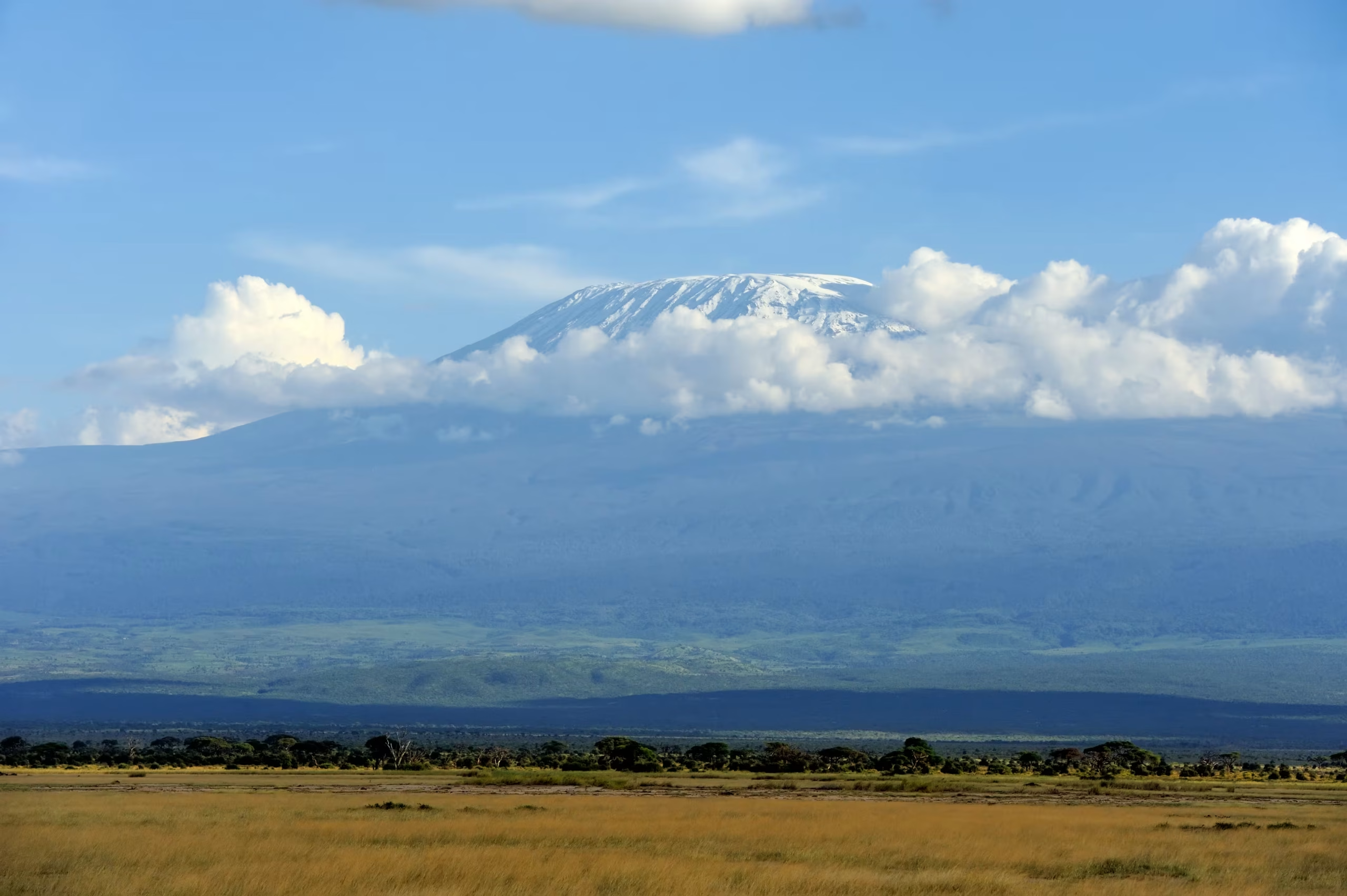
Kilimanjaro is a free-standing volcano rising straight off the plain, which is why it looks the way it does from a hundred kilometres away. It has three cones. Kibo carries the summit and the remaining ice; Mawenzi is the jagged one you walk past; Shira collapsed long ago and is now the plateau you cross on the western routes.

You walk through five climate zones in about five days — farmland, rainforest, heath and moorland, alpine desert, and finally the arctic zone at the top. Very few places on earth compress that much into that little distance.

It requires no technical skill. There is no rope, no ice axe and no climbing on any normal route. What it requires is time, because the only thing that reliably gets people to the summit is spending enough days going up slowly.

That is the single most important thing on this page. Success on Kilimanjaro tracks the length of the route almost exactly. The five-day Marangu climb is the cheapest and the one that fails most often. If you are going to spend this much money and this much annual leave, buy the extra days.
Getting there

Where to start, and how to arrive.

01

Kilimanjaro International Airport

The way almost everyone comes

JRO sits between Moshi and Arusha, about forty-five minutes from Moshi and an hour from Arusha, with direct flights from Amsterdam, Doha, Istanbul, Addis and Nairobi. We meet every climber at arrivals and drive you straight to your hotel — there is no onward domestic connection to worry about.

The trade-off

Arrive at least a full day before you climb. Kit check and briefing happen the afternoon before, and a delayed bag is recoverable with a spare day and very difficult without one.

02

From Nairobi or Dar es Salaam

If the fares work better

A short hop from Nairobi to JRO, or a shuttle bus overland from Nairobi to Arusha in about six hours. From Dar es Salaam there are frequent flights, or the road, which is long. Useful if you are already in the region or the international fare into Nairobi is considerably cheaper.

The trade-off

The overland shuttle from Nairobi involves a land border crossing and a whole day. Do not schedule it for the day before your climb.

03

To the gate itself

The morning you start

Machame and Marangu gates are 45 to 60 minutes from Moshi. Londorossi, for Lemosho and the Northern Circuit, is around three hours west. Rongai’s Nalemuru gate is about four hours round the northern side. Your transfer, permits and registration are all handled for you.

The trade-off

The western and northern gates mean a long drive before you walk a step. On Lemosho and Rongai, day one is shorter than it looks on paper for exactly this reason.

Every route

Seven ways up. They are not equal.

Choosing the route is the most important decision you will make about this climb, and it matters far more than how fit you are. Longer routes give your body more time to make red blood cells, and that — not willpower — is what gets people to Uhuru. Here is all seven, honestly.

Northern Circuit

9 days

The longest, and the one that gets most people to the top

Distance
~98 km
Sleeping
Tents
Approach
Londorossi · west, then anti-clockwise around Kibo

Starts as Lemosho, crosses the Shira Plateau, then instead of turning south it swings right around the quiet northern slopes of Kibo before coming to the summit from the east. Nine days on the mountain, more time above 4,000 m than any other route, and almost nobody on the northern half of it.

What it gives you

The best acclimatisation profile on the mountain · the highest summit rates · genuine solitude for three or four days · the most varied scenery of any route

What it costs you

The most expensive, because nine days of park fees and crew wages · a long way from anywhere if you have to come down

How we rate it for summiting

Lemosho

7–8 days

The best balance of price, scenery and success

Distance
~70 km
Sleeping
Tents
Approach
Londorossi · west

In from the west through proper rainforest, over the Shira Plateau with Kibo ahead of you for two days, then joining the Machame path at Barranco for the southern approach. Quiet for the first half, and the eight-day version has a strong climb-high sleep-low profile.

What it gives you

Excellent acclimatisation · the finest approach on the mountain · quiet for the first three days · high summit rates

What it costs you

Costs more than Machame · a long drive to the gate · busy once it joins Machame at Barranco

How we rate it for summiting

Machame

6–7 days

The popular one, and popular for good reason

Distance
~62 km
Sleeping
Tents
Approach
Machame · south

The most-walked camping route on Kilimanjaro. A steep first day through dense forest, then Shira, the Lava Tower at 4,600 m, the Barranco Wall and the southern traverse. The seven-day version acclimatises well; the six-day version is where the numbers drop away.

What it gives you

Strong climb-high sleep-low profile · the Barranco Wall · superb scenery · cheaper than Lemosho

What it costs you

By far the busiest route in high season · a hard first day · the six-day version has a materially lower success rate

How we rate it for summiting

Rongai

6–7 days

The dry side, and the gentlest gradient

Distance
~73 km
Sleeping
Tents
Approach
Nalemuru · north-east, near the Kenyan border

The only route approaching from the north. It sits in the rain shadow, so it is the driest option and the sensible choice in the wetter months. The gradient is steadier than the southern routes and the country is more remote and emptier, with a real chance of seeing wildlife low down.

What it gives you

The driest route · gentle, steady gradient · very quiet · descends by Marangu so you see two sides

What it costs you

Less varied scenery than the west · a long drive round the mountain to the gate · weaker climb-high sleep-low than Machame or Lemosho

How we rate it for summiting

Marangu

5–6 days

The only huts, and the lowest summit rate

Distance
~72 km
Sleeping
Huts
Approach
Marangu · south-east

The oldest route and the only one with permanent dormitory huts rather than tents. It goes up and comes back down the same path, which means no climb-high sleep-low at all and no new ground on the descent. It is the cheapest way up the mountain and the one that turns most people back.

What it gives you

Dormitory huts with beds and dining halls · the shortest and cheapest · the easiest walking underfoot · best in rain

What it costs you

The lowest summit rate of any route · the same path up and down · poor acclimatisation profile · huts are crowded and shared

How we rate it for summiting

Shira

7–8 days

Superseded by Lemosho, and for a reason

Distance
~56 km
Sleeping
Tents
Approach
Shira Gate · west, by vehicle to 3,600 m

The older western approach. A vehicle takes you to Shira Gate at about 3,600 m, so you begin your first day’s walking at an altitude Lemosho climbers reach on day three. Being driven that high that fast is a poor way to start, and Lemosho now does the same route better.

What it gives you

Reaches the Shira Plateau immediately · shorter walking distance overall

What it costs you

You start at 3,600 m without acclimatising — a real altitude sickness risk · Lemosho covers the same ground properly · we steer almost everyone to Lemosho instead

How we rate it for summiting

Umbwe

6 days

The steepest, and not for a first climb

Distance
~53 km
Sleeping
Tents
Approach
Umbwe · south

The shortest and most direct line on the mountain, climbing a forested ridge very steeply for two days. It is beautiful, exceptionally quiet, and hard. It gains altitude faster than any other route, which is why the success rate is poor despite the people who attempt it usually being experienced.

What it gives you

The most dramatic approach · almost no other climbers · short

What it costs you

Very steep, sustained climbing · the fastest altitude gain on the mountain · low summit rates · sometimes used to reach the Western Breach, which we do not run

How we rate it for summiting
Route Days Distance Sleeping Traffic For summiting
Northern Circuit9 days~98 kmTentsVery quiet
Lemosho7–8 days~70 kmTentsQuiet, then busy
Machame6–7 days~62 kmTentsBusiest
Rongai6–7 days~73 kmTentsVery quiet
Marangu5–6 days~72 kmHutsBusy
Shira7–8 days~56 kmTentsQuiet
Umbwe6 days~53 kmTentsAlmost empty

Two things we will not sell you. The Western Breach is a shorter, steeper way into the crater and it has killed climbers through rockfall; we do not run it at any price. And we will not put a first-time climber on five-day Marangu and take the money knowing what the odds are.

Everyone descends the same way. All southern routes come down via Mweka, which is why your last night is at Mweka Camp regardless of how you went up. Marangu and Rongai are the exceptions, returning down the Marangu path.

If you only take one thing from this page: add days before you add anything else. An extra night on the mountain does more for your chances than any kit, any training programme and any tablet.

See the Lemosho route day by day, with the elevation profile →
When to go

The month decides a great deal.

Jan–MarWarmest and clear

Warmer nights, generally settled weather and a good chance of snow on the summit cone. Quieter than the northern-summer months.

Exceptional
Jun–OctThe main season

Dry, cold and reliable. July to September is the busiest stretch on the mountain; the popular routes feel it.

Exceptional
Nov–DecShort rains

Afternoon rain low down, often clear higher up. Fewer people and lower prices, and the northern routes stay driest.

Good
Apr–MayLong rains

Sustained heavy rain through the forest, mud on the trails and cloud on the summit. Some operators still sell it. We would rather move your dates.

Low season
Full moonAny month

Summit night on a clear full moon needs barely a torch and is genuinely extraordinary. Worth planning your dates around if you can.

Exceptional
Christmas & New YearDec–Jan

Excellent conditions and the mountain at its most crowded and most expensive. Book many months ahead.

Good
Compare with the other parks →
What to see

What the mountain puts you through.

1,800–2,800 m

The rainforest

Where every western and southern route begins. Dripping, close and loud, with colobus overhead and blue monkeys in the canopy. The one section where rain is close to guaranteed.

2,800–4,000 m

Heath and moorland

Above the trees: giant heather, then the giant groundsels and lobelias that grow nowhere but East African mountains. The Shira Plateau crosses the whole of it.

4,600 m

Lava Tower and the Barranco Wall

The climb-high sleep-low afternoon that makes the southern routes work, followed by the Barranco Wall — a scramble that uses hands but needs no rope, and the best morning on the mountain.

4,000–5,000 m

The alpine desert

The saddle between Kibo and Mawenzi. Almost nothing lives here. Frozen at night, fiercely bright by day, and the point at which most people start feeling the altitude properly.

5,685–5,895 m

Stella Point to Uhuru

The last hour along the crater rim, past the remaining glaciers, in the light. It is short, flat by comparison and the hardest walking most people ever do.

What to do

Ways to be on it.

01

Climb to Uhuru Peak

Seven to nine days on Lemosho, Machame, Rongai or the Northern Circuit, with a full crew, tents or huts and daily health checks.

02

Take the Northern Circuit

Nine days around the quiet northern side of Kibo. The longest route on the mountain and the highest success rate of any of them.

03

Sleep at Crater Camp

A night at about 5,750 m inside the summit crater, beside the ice. Extraordinary, and a serious undertaking that we only run for climbers who have already acclimatised well.

04

Walk the lower slopes

Day walks in the forest zone and to the Shira Plateau without committing to a summit attempt. Good for anyone travelling with a group that is climbing.

05

Climb Meru first

Four days on Mount Meru at 4,562 m, two clear days off, then Kilimanjaro. The best acclimatisation available anywhere in Tanzania.

06

Chagga villages and Materuni

The farmland below the gates — coffee smallholdings, irrigation furrows centuries old, and the waterfall at Materuni. The usual first or last day.

Where to stay

The route decides the climb.

You do not choose a hotel on Kilimanjaro. You choose a route, and the route hands you either a dormitory hut or a tent in a fixed place each night. What is actually worth deciding is how many nights there are.

“Nobody fails Kilimanjaro because they were not fit enough. They fail because they took the short route, or they walked too fast on the first day.” Gabriel Nkini · founder
Only on Marangu

Mountain huts

A night here — a bunk in a shared A-frame hut, a mattress, a dining hall and other climbers all around you.

Marangu is the only route with permanent huts: dormitory A-frames at Mandara, Horombo and Kibo, with mattresses, communal dining and, low down, running water. It is drier and warmer than canvas and there is no camp to strike each morning. The catch is the route itself — Marangu goes up and comes down the same path, has the weakest acclimatisation profile on the mountain and the lowest summit rate.

Best for
Anyone who will not sleep in a tent, the wetter months, tight budgets
Less good for
Your chances of summiting — and privacy, of which there is none
Where
Mandara 2,700 m · Horombo 3,720 m · Kibo 4,700 m
Every other route

Tented camps

A night here — canvas at a park campsite, a mess tent with hot food in it, and Kibo above you when you unzip the door in the morning.

Machame, Lemosho, Shira, Rongai, Umbwe and the Northern Circuit all camp. Your crew carries, pitches and strikes everything and cooks all of it. Sites are fixed by the park, so you sleep where the route says, and the higher camps are cold, bright and completely exposed. This is how the great majority of climbs are done.

Best for
Almost everyone — and every route with a good summit rate
Less good for
Anyone who genuinely cannot sleep on the ground
Where
Park-designated campsites · Shira, Barranco, Karanga, Barafu and the rest
Worth the money

Upgraded camp

A night here — a tent you can stand up in, a thicker mat, a chair at dinner and your own toilet tent.

The same route and the same sites, with better equipment carried in: walk-in sleeping tents, proper insulated mats, a heated mess tent with a table and chairs, and a private toilet rather than the park facilities. It buys sleep and dignity rather than altitude, which after five days is not nothing.

Best for
Longer routes, colder months, anyone who sleeps badly
Less good for
The tightest budgets — it does add real cost
Where
Available on every camping route
The extreme end

Crater Camp · 5,750 m

A night here — a tent inside the summit crater beside the glaciers, at an altitude where sleep barely happens.

A night in the crater itself, just below Uhuru, next to the ash pit and the remaining ice. It is one of the most remarkable places anyone can sleep and it is genuinely serious: sleeping this high carries real risk of altitude illness, and we only run it for climbers who have come up a long route and acclimatised visibly well.

Best for
Experienced trekkers, photographers, second attempts
Less good for
First-timers, short routes, anyone who has struggled below 5,000 m
Where
Inside the Kibo crater · by prior arrangement only
Before and after

Moshi and the Machame road

A night here — a hot shower, a garden, a cold drink, and the whole mountain filling the sky above the town.

You need a night either side at minimum. Moshi sits forty-five minutes from the gates and has everything from hostels to comfortable hotels; the coffee farms up the Machame road are quieter and put you closer to the start. Kit checks and briefings happen here the evening before you climb.

Best for
The night before, the night after, and the recovery day
Less good for
Nothing — do not try to fly in and start the same day
Where
Moshi town · the Machame and Marangu roads

Every night on the mountain is at a park-designated site. There is no choosing a nicer camp, no upgrading the view and no staying an extra night where you like it. Marangu has huts; every other route is tents, pitched and struck by your crew.

What you can change is the standard of the camp. Roomier sleeping tents, thicker mats, a proper mess tent with a table and chairs, and a private toilet tent rather than the park long-drops. None of it will get you to the summit, but after five days it changes how the week feels considerably.

Book a night either side in Moshi. Kit checks and briefings happen the day before, and the first thing you will want afterwards is a shower and a bed that is not on a slope.

Practical

Before you come.

Fees

KINAPA charges a conservation fee per person per 24 hours, plus camping or hut fees, a rescue fee and a crew fee. These are the largest single element of any Kilimanjaro price. Rates change annually and ours are quoted inclusive, so there is nothing to settle at the gate.

Fitness

Kilimanjaro is a walk, not a climb, and no technical skill is needed. What it asks for is the ability to walk five to seven hours a day for a week, then eleven to fourteen hours on summit night. Regular hill walking in the months beforehand matters more than gym work.

Altitude

This is what decides your climb, not fitness. Above about 3,500 m most people feel something. The defences are a longer route, a slower pace and drinking far more than feels necessary. Our guides carry pulse oximeters and check twice daily, and they will turn you round if the numbers say so.

Crew and porter welfare

A climb needs roughly three crew per climber. There are legal limits on porter loads and minimum wages, and they are not universally observed. We publish what we pay, weigh loads at the gate, and feed and equip our crew properly. If a quote you have been given looks impossibly cheap, this is where the money has been taken from.

Kit

Layers rather than one heavy coat, boots already broken in, a bag rated to at least −10 °C, and a head torch. Most of it can be hired in Moshi and we will send a full list once you book.

Health and visas

A yellow fever certificate is required if you arrive from a country with risk of transmission. Malaria prophylaxis matters for Moshi and Arusha rather than the mountain. Most nationalities can obtain a Tanzanian visa on arrival or online in advance.

Questions

The ones we are asked most.

How hard is it really?

The walking is not technically difficult and needs no skill. Summit night is eleven to fourteen hours, starting around midnight, in temperatures well below freezing, on very little oxygen. Most people describe it as the hardest physical thing they have done, and most people still get up.

Which route should I take?

Lemosho over seven or eight days, or the Northern Circuit over nine, if the budget allows. Machame over seven if it does not. Rongai if you are climbing in the wetter months. Marangu only if sleeping in a hut genuinely matters more to you than summiting.

What is the success rate?

It depends almost entirely on the route. Nine-day routes run very high; five-day Marangu is far lower. Anyone quoting you a single company-wide number across all routes is quoting marketing. We will tell you the figure for the specific route and length you are considering.

Do I need training?

Yes, and the right kind. Long walks on hills, back to back, carrying a daypack. Running and gym work help less than you would think. Time on your feet is what transfers.

What about altitude sickness?

Some degree of it is normal above 3,500 m — headache, poor sleep, loss of appetite. What is not normal is confusion, breathlessness at rest or loss of coordination, and the response to those is immediate descent. We check oxygen saturation twice a day, every day.

Should I take Diamox?

Many climbers do and it helps. It is a prescription medicine with side effects, so it is a conversation with your own doctor before you travel, not with us. It reduces the risk; it does not remove it, and it is not a substitute for a longer route.

How cold does it get?

Camps are usually a little below freezing. Summit night is commonly −10 to −20 °C with wind on top of that. The heat in the forest on day one and the cold at Stella Point are the two extremes of the same week.

Can I climb it and go on safari?

Yes, and most people do. Climb first while you are fresh, then the northern circuit or Zanzibar afterwards. Two weeks covers a seven-day climb, a short safari and a few days at the coast.

How old do I have to be?

The park minimum is ten. In practice we would want to talk about anyone under about fourteen, and there is no upper limit — people in their seventies summit every year.

Begin here

Tell us the month, and we will place you.

Where you should be depends almost entirely on when you can travel. Tell us that and we will say honestly whether Mount Kilimanjaro is right for you that month — or whether somewhere else would serve you better.

Loading itinerary…
Saved Trips