

Active Kilitop and Safaris

'
A walking guide with binoculars, an elephant in the bush behind him
Walking safari — 2400×1400
Experience · Ruaha, Nyerere & the north

You will see less. That is the point.

Three hours on foot behind an armed ranger, at the pace the ground allows. You will not get closer to big game — you will get further from it. What you get instead is everything a vehicle drives past at forty kilometres an hour.

On footTwo to three hours
StartsFirst light
With youArmed ranger & guide
Minimum ageUsually twelve
WhereRuaha · Nyerere · Arusha
01

Three things to get straight first.

Walking safaris are sold with a photograph of two people silhouetted against a sunset and no explanation at all. These are the three that decide whether it belongs in your trip.

A lot of “walking safaris” are a stroll round the lodge.

There is an enormous difference between a forty-minute nature walk on a property’s own land and a proper bush walk inside a park with a licensed walking guide and an armed ranger. Both get called the same thing on an itinerary. Ask which one you are being sold, and if the answer is vague, it is the first.

The armed ranger is not decoration.

Every walk inside a Tanzanian national park goes out with a park ranger carrying a rifle. He is there because you are on foot in a place with buffalo and elephant in it. Nobody expects to use it and it is almost never used — but the rules you are given exist for a reason and they are not negotiable.

You are trading sightings for a change of scale.

From a vehicle you cover thirty kilometres and see the big things. On foot you cover four and see the small ones — tracks, dung, a kill from three nights ago, the plant your guide will make you smell. If you measure a morning by how many lions you found, do not book this.

02

The briefing you get before you set off.

This is close to what your guide will actually say, standing at the vehicle, before anyone takes a step. It takes about four minutes and it is the most important four minutes of the morning.

Single file, and nobody overtakes the ranger.

The ranger walks first, the guide second, then you, then a second scout at the back. The line does not spread out and it does not gap. If you want to look at something, say so and the whole line stops.

Why  It gives one person a clear view forward and one a clear view back. A spread-out group has neither.

Talk at a murmur, or not at all.

Everything you are there to hear is quiet — an alarm call, a branch going, francolin getting up on the far side of a thicket. Your guide will use hand signals: flat palm for stop, finger down for crouch.

Why  Noise is also how you surprise a buffalo, which is the thing nobody wants to do.

Wear the colours the bush wears.

Greens, browns, khaki, grey. Not white, which flags for a kilometre. Not black or dark blue — tsetse flies are drawn to exactly those, which is why the traps set for them are made of blue and black cloth.

Why  You are trying to be a shape rather than a signal.

No scent at all.

No perfume, no aftershave, no strongly fragranced sunscreen or insect repellent if you can help it. Sound travels a few hundred metres. Smell travels much further, and it arrives before you do.

When the line stops, you stop. When it crouches, you crouch.

Without asking why first. The reason will be explained in a moment; the moment matters more.

Whatever happens, do not run.

This is the one absolute. Running turns you into prey to something that was not treating you as prey, and you cannot outrun anything out there anyway. Stand still, stay behind the ranger, wait to be told.

Never step in front of the line for a photograph.

It is the single most common thing guides have to stop, and it puts you between the ranger and whatever he is watching. Take the picture from where you are or ask the line to move.

Tell us the awkward things before we start.

A knee that gives out, an inhaler, a bee allergy, how far you can realistically walk in soft sand. Nobody is judging and it changes the route we choose. Telling us an hour in does not.

03

What the ground tells you.

The change is not that you see different animals. It is that the ground becomes readable, and a guide who has spent thirty years on it can take a patch of dust and tell you what walked over it and roughly when.

Tracks and their order

A hyena over a lion over a vehicle tyre is a sequence, and the sequence is a story with a time in it. Which print sits inside which tells you the order of the night.

Dung, which is more interesting than it sounds

What has been eating what, how long ago, and in the case of elephant, roughly how big the animal was. Also where the seeds of half the trees around you came from.

The things a vehicle cannot stop for

A leopard tortoise, a dung beetle rolling something twice its size, the underside of a leaf, a spitting cobra’s track, an aardvark hole with something else living in it now.

Smell and sound as information

Wild basil crushed between your fingers, the ammonia of a fresh rhino midden, an oxpecker giving away buffalo you cannot see. On foot you are inside the information rather than driving through it.

The scale of things

A giraffe is a different animal when you are standing on the same ground as it. So is an elephant at two hundred metres with nothing between you. That is the whole argument for walking, in one sentence.

Where you fit

The honest and slightly uncomfortable part. On foot you are neither the largest nor the fastest nor the best equipped thing present, and everything around you knows it. People find this either wonderful or deeply unrelaxing, and they usually know which within twenty minutes.

04

Four places worth walking.

Walking is licensed park by park and area by area, and the four below are where it is genuinely worth building a day around rather than tacking on.

Walking safari — 1600×1100
The best of them

Ruaha

Big, empty, and set up for it. Sand rivers to follow, baobabs, and a real chance of walking within sight of elephant with the guide choosing the line. The southern parks were built around walking in a way the northern circuit never was.
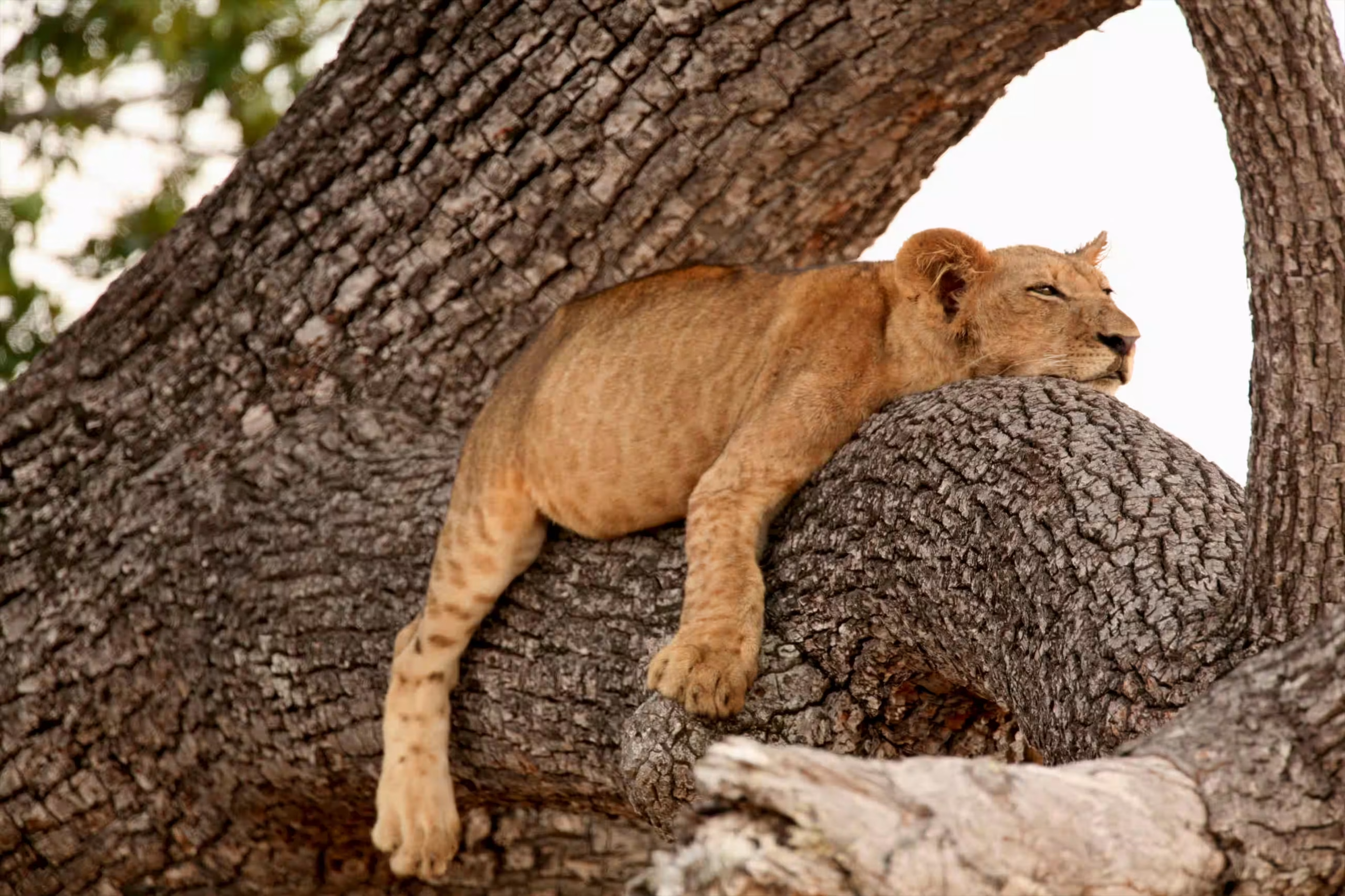
A lion cub asleep in the fork of a tree
Walking safari — 1600×1100
Walking and boats together

Nyerere

The other southern option, and the one that combines a morning on foot with an afternoon on the Rufiji. Miombo and riverine forest rather than open plain, so the walking is closer, greener and more about birds and tracks than long views.

The easy first walk

Arusha National Park

The northern circuit’s walking park, and the reason is simple: there are no lion in it. Buffalo are the animal to respect here. Forty-five minutes from Arusha, so it works as a first or last day, and you walk under Mount Meru with giraffe and colobus about.

Empakaai & Olmoti

Ngorongoro Highlands

The best walking country in northern Tanzania, and almost nobody uses it. Empakaai is a collapsed caldera six to eight kilometres across with a soda lake and flamingos on the floor, 300 metres below a forested rim at around 3,200 metres. Do it as a two-hour descent and climb, or keep walking north-west and drop 2,600 metres over five days to Lake Natron and Ol Doinyo Lengai. The highlands trek, day by day →

Before you book

Fitness is less of an issue than people think, and knees are more. The pace is slow — you stop constantly — and three hours on the flat is well within most people. What catches people out is uneven ground, soft sand, and getting up and down riverbanks. If a knee or a hip is unreliable, say so and we will pick flatter country rather than quietly hoping.

There is a minimum age and it is enforced. Twelve is common, some areas set it higher, and no operator will bend it. A child who cannot be relied on to stand still and stay quiet on command is not a safety risk to themselves so much as to the whole line.

05

Should you walk?

We would rather you skipped it than spent a morning being quietly terrified or quietly bored.

Yes, if
  • You have already done a few game drives and want the place to become real rather than televised.
  • You like being told things. A good walking guide is a naturalist, and this is three hours of that.
  • You are going to Ruaha or Nyerere anyway, where walking is a proper part of the offering rather than an add-on.
  • Birds, trees, insects and tracks interest you as much as the big five.
Probably not, if
  • You have three days in Tanzania and one of them would go on this. Do the drives.
  • You want photographs of predators. You will not get close on foot and you should not want to.
  • Standing still while something large decides what it thinks of you would ruin your morning rather than make it.
  • You are travelling with children under about twelve, or with anyone who cannot walk unassisted on rough ground.
06

Questions we get asked.

Is it dangerous?

It is a managed risk rather than no risk, and pretending otherwise would be dishonest. You are on foot in a national park with an armed ranger and a guide whose whole job is reading what is ahead. Serious incidents on guided walks in Tanzania are rare. The rules in the briefing are what make them rare, which is why guides are unsentimental about people who ignore them.

What actually happens if we meet something big?

Almost always nothing, because the guide saw it first and put a thicket, a riverbank or four hundred metres between you before you noticed. If something is closer than that you will be stopped, moved quietly, or asked to stand absolutely still while it works out that you are not interesting. Buffalo and elephant are the two that get respect; lion on foot is far less common than people imagine.

How far do you actually walk?

Three to six kilometres in two or three hours, which sounds like nothing and is not, because you stop every few minutes and the ground is uneven. Multi-day walking safaris with fly-camps exist in Ruaha and Nyerere and cover more, but they are a different trip and need planning around.

Can I walk in the Ngorongoro Crater itself?

Not on the floor. The crater floor is vehicles only and always will be — nobody walks among that density of lion and buffalo at any price. The highlands above the rim are a completely different matter: Empakaai, Olmoti and the whole northern escarpment are walked on foot with an armed ranger, and they are the best walking in northern Tanzania. Most people do not know the two things are separate.

Can I do a walking safari in the Serengeti?

Yes, in designated areas and with a licensed walking operator, and it is good — particularly in the wilderness zones away from the central circuit. It is not something you can decide on the morning; it has to be arranged with your camp before you arrive.

What should I wear?

Neutral colours, long trousers you can push through grass in, proper closed walking shoes rather than trainers with no grip, a hat, and a long-sleeved shirt for sun and thorns. Not white. Not black or dark blue, because of tsetse. Leave the daypack light — water, camera, and that is genuinely it.

Is there a toilet?

No. This is the question everybody wants to ask and nobody does. You go before you leave the vehicle, and if you need to on the walk you tell the guide, who will find you a bush and turn the line around.

Put a walk in the right park.

Tell us which parks you are going to and we will tell you where a walk is worth the morning and where it is a lodge stroll dressed up. If your route does not have a good one in it, we will say so.

Or call +255 762 914 714
Loading itinerary…
Saved Trips
